

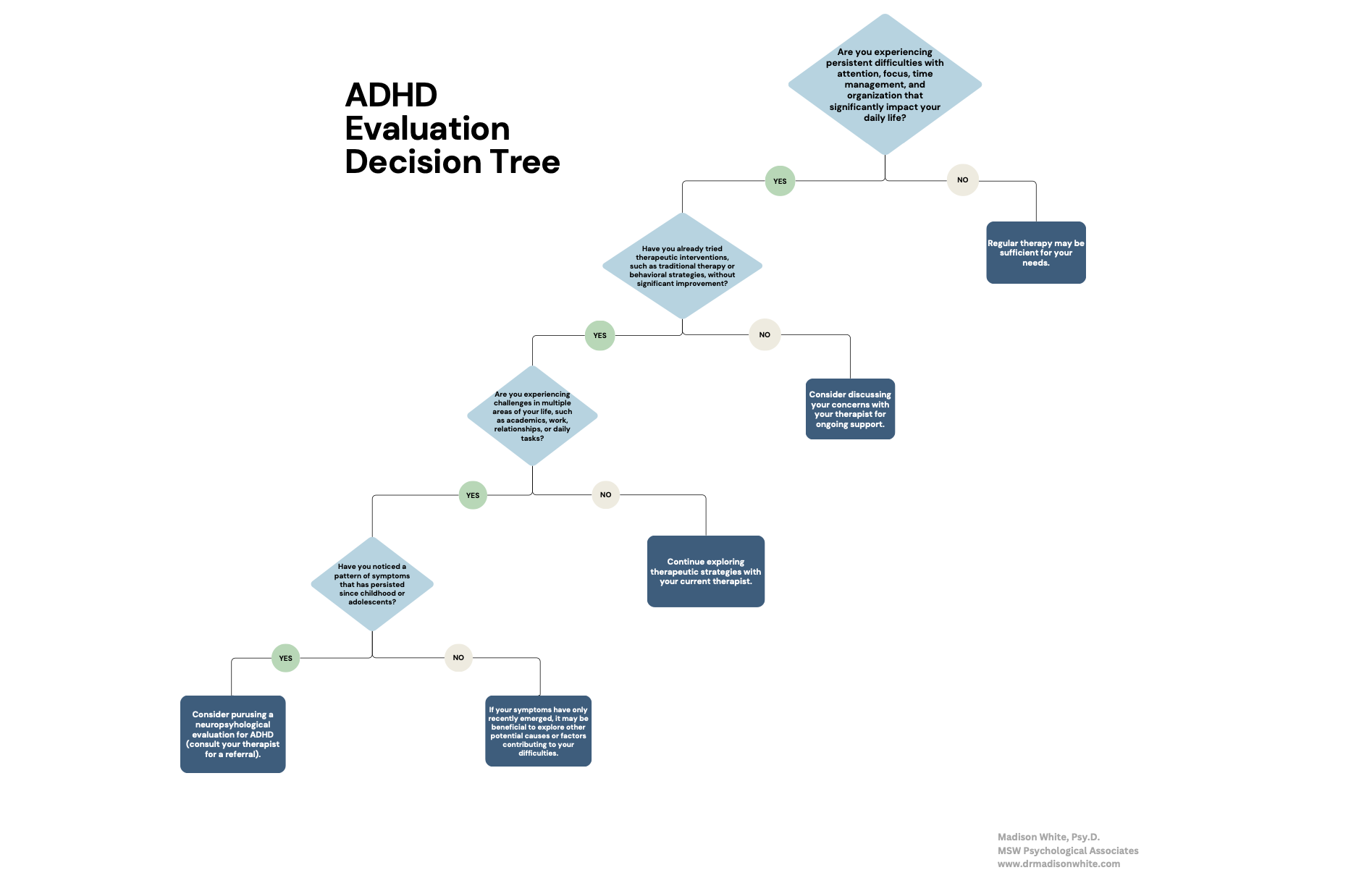
Have you ever wondered why certain aspects of everyday life seem harder for you than they do for other people? Maybe you struggle to stay organized, frequently procrastinate despite your best intentions, or feel like you're constantly working twice as hard just to keep up.
Perhaps you've spent years attributing these challenges to anxiety, stress, or simply not trying hard enough. But lately, you've started wondering: Could this actually be ADHD?
For many adults, recognizing the possibility of Attention-Deficit/Hyperactivity Disorder (ADHD) raises another question: How do I know whether I should pursue a formal ADHD evaluation?
If you're an adult in Connecticut considering ADHD testing, understanding when an evaluation may be helpful, and what type of assessment you actually need, can make the process feel less overwhelming.
Why ADHD Can Be Difficult to Recognize in Adults
ADHD is a neurodevelopmental condition that affects attention regulation, executive functioning, and impulse control. According to the CDC, ADHD symptoms can persist into adulthood, although the way they present may change over time. Some people have spent years developing strategies to compensate for their difficulties. They may have performed well academically, maintained successful careers, or appeared highly organized to others while privately struggling to manage daily responsibilities.
Adult ADHD can show up in ways that aren't always obvious, including:
Difficulty initiating tasks, even when they're important
Chronic procrastination and trouble following through
Frequently misplacing belongings or forgetting responsibilities
Feeling overwhelmed by everyday planning and organization
Difficulty managing time or estimating how long tasks will take
Trouble sustaining attention during conversations, reading, or work
Restlessness or difficulty relaxing
Inconsistent performance despite considerable effort
For some adults, particularly women and individuals who have developed strong compensatory strategies, these challenges may have gone unrecognized for years.
Importantly, experiencing these difficulties doesn't automatically mean you have ADHD. Anxiety, depression, trauma, sleep problems, and other conditions can produce similar symptoms.
This overlap is one reason a thoughtful diagnostic evaluation can be helpful.
When Should You Consider an Adult ADHD Evaluation?
Determining whether to pursue an ADHD evaluation isn't always straightforward. As outlined in CHADD's guide to diagnosing ADHD in adults, the diagnostic process involves examining an individual's developmental history, symptom patterns, and the extent to which these difficulties interfere with everyday functioning, while also considering other possible explanations. Although there is no single point at which someone needs to pursue ADHD testing, certain experiences and challenges may suggest that a formal evaluation could provide valuable diagnostic clarity. Some common reasons adults seek an assessment include:
1. You've Suspected ADHD for Years but Never Received a Diagnosis
Maybe you've always struggled with organization, attention, or completing tasks, but never considered ADHD because you performed well in school or didn't fit the stereotypical picture of someone with the condition. You may have started recognizing yourself in descriptions of adult ADHD or noticed patterns that have persisted across different stages of your life. A diagnostic evaluation can help determine whether those longstanding difficulties are consistent with ADHD or better explained by something else.
2. You're Unsure Whether Your Symptoms Are ADHD, Anxiety, or Something Else
One of the most common reasons adults pursue neuropsychological evaluations is diagnostic uncertainty. ADHD and anxiety, for example, can both involve difficulty concentrating, restlessness, forgetfulness, and feeling overwhelmed. However, the underlying reasons for these difficulties may be different. Someone with ADHD might struggle to complete a task because of difficulties with initiation, planning, or sustaining attention. Someone experiencing anxiety might struggle with the same task because they're worried about making mistakes or uncertain about the outcome. Of course, ADHD and anxiety can also occur together. A comprehensive evaluation considers your developmental history, current symptoms, emotional functioning, and patterns of cognitive strengths and weaknesses to help clarify what's contributing to your difficulties.
3. Your Symptoms Are Interfering With Everyday Life
Everyone occasionally procrastinates, forgets appointments, or struggles to concentrate. However, when these challenges consistently interfere with work, relationships, household responsibilities, or personal well-being, it may be worth exploring them more closely.
For example, you might find yourself:
Missing deadlines despite putting in considerable effort
Struggling to manage bills, appointments, or household tasks
Feeling chronically overwhelmed by responsibilities
Having difficulty maintaining routines
Experiencing conflict in relationships related to forgetfulness or follow-through
Feeling exhausted from constantly trying to compensate for your difficulties
An evaluation can help identify factors contributing to these challenges and guide recommendations for addressing them.
4. You've Tried Treatment or Coping Strategies Without Understanding Why You're Still Struggling
Perhaps you've participated in therapy, developed organizational systems, or tried various productivity strategies, but certain difficulties continue to interfere with your life. This doesn't necessarily mean you have ADHD. However, it may suggest that additional diagnostic clarification would be helpful. Understanding whether your challenges are related to ADHD, anxiety, depression, executive functioning difficulties, or a combination of factors can inform a more individualized treatment approach.
Do You Need a Comprehensive Neuropsychological Evaluation to Diagnose ADHD?
Not everyone who suspects ADHD needs comprehensive neuropsychological testing.
As the CDC explains, there is no single test that can definitively diagnose ADHD. Instead, an accurate diagnosis requires a thorough clinical assessment that considers an individual's developmental history, current symptoms, functional difficulties, and other potential explanations for their experiences. While comprehensive neuropsychological testing is not necessary for every ADHD diagnosis, it can provide valuable additional information, particularly when symptoms overlap with other mental health or neurodevelopmental conditions. A more extensive evaluation may be especially helpful when:
The diagnosis remains unclear.
ADHD symptoms overlap with anxiety, depression, trauma, or other conditions.
There are concerns about autism or additional neurodevelopmental differences.
You want a more detailed understanding of your cognitive strengths and challenges.
Previous treatment or evaluations haven't adequately explained your difficulties.
You need individualized recommendations based on a broader assessment of your functioning.
Neuropsychological testing does not diagnose ADHD based on a single test score. Instead, test findings are interpreted alongside clinical interviews, developmental history, behavioral observations, and other relevant information. The goal is not simply to determine whether you meet criteria for ADHD, but to develop a more complete understanding of how you function and what types of support may be beneficial.
What Does Adult ADHD Testing Look Like in Connecticut?
If you're seeking an adult ADHD evaluation in Connecticut, you may have several options, including assessments conducted by psychologists, psychiatrists, and other qualified healthcare professionals. The appropriate type of evaluation depends on your symptoms, diagnostic history, and goals. In my practice, I provide comprehensive virtual neuropsychological evaluations for adults throughout Connecticut.
My evaluation process includes:
1. Comprehensive clinical interview: We begin by discussing your current concerns, developmental history, educational and occupational experiences, mental health history, and everyday functioning.
2. Cognitive and psychological assessment: Testing examines relevant areas of cognitive and emotional functioning. The specific measures are selected based on your presenting concerns and the questions we're trying to answer.
3. Collateral information: When appropriate and with your permission, information from someone familiar with your history may help provide additional perspective on longstanding patterns of functioning.
4. Diagnostic integration: I consider information from multiple sources to evaluate ADHD and other possible explanations for your symptoms.
5. Feedback and individualized recommendations: Following the evaluation, we review the findings, discuss diagnostic impressions, and identify practical next steps. Recommendations may include psychotherapy, executive functioning coaching, organizational strategies, medication consultation, or other appropriate supports. The purpose is to provide more than a diagnostic label. It's to help you better understand your experiences and identify strategies that align with your individual needs.
Can You Complete an ADHD Evaluation Virtually in Connecticut?
Yes. Certain psychological and neuropsychological assessment procedures can be administered virtually when appropriate measures and standardized remote administration procedures are used. My practice provides virtual evaluations for adults throughout Connecticut, including Fairfield County communities such as Wilton, Westport, Greenwich, Stamford, Norwalk, and Ridgefield, as well as other areas of the state.
Virtual assessment allows eligible clients to complete the evaluation process from an appropriate private location without traveling to a testing office. However, not every assessment measure or clinical question is suitable for remote administration. The evaluation approach should be selected based on your individual needs and the limitations of the available testing methods.
How Much Does a Comprehensive ADHD Evaluation Cost in Connecticut?
The cost of adult ADHD assessments varies depending on the provider, the complexity of the evaluation, and the services included. A focused diagnostic assessment may cost less than a comprehensive neuropsychological evaluation because the scope and amount of testing differ.
My comprehensive private-pay neuropsychological evaluations are $4,250, with payment divided into three installments corresponding to the intake, testing, and feedback stages. HSA/FSA funds may be used when eligible under your plan.
Before pursuing an evaluation, it's worth considering what questions you want answered and whether a comprehensive assessment is necessary to address them.
How Do You Know Whether an Evaluation Is Worth Pursuing?
You don't need to be certain that you have ADHD before seeking an assessment. In fact, diagnostic uncertainty is often the reason people pursue evaluations in the first place. It may be worth exploring your options if you've been struggling with longstanding patterns of inattention, disorganization, procrastination, or executive functioning difficulties and want to better understand what's contributing to them. At the same time, an evaluation isn't always the necessary first step. Depending on your circumstances, a clinical consultation, psychotherapy, or discussion with your existing healthcare provider may be a more appropriate starting point. The most useful evaluation is one that addresses your specific questions and helps you make informed decisions about what comes next.
Interested in Adult ADHD Testing in Connecticut?
I'm Dr. Madison White, a Connecticut-licensed clinical psychologist based in Fairfield County. I specialize in comprehensive virtual neuropsychological evaluations for adults, with a particular focus on ADHD, autism, executive functioning, and complex or previously overlooked presentations. My approach emphasizes careful diagnostic clarification, an understanding of each person's unique experiences, and practical recommendations that can be applied to everyday life.
If you're considering an evaluation and aren't sure whether comprehensive testing is appropriate for you, I offer a complimentary 15-minute consultation to discuss your concerns and the assessment process.
Learn more about adult ADHD testing in Connecticut or schedule a free consultation to explore whether an evaluation may be a good fit.